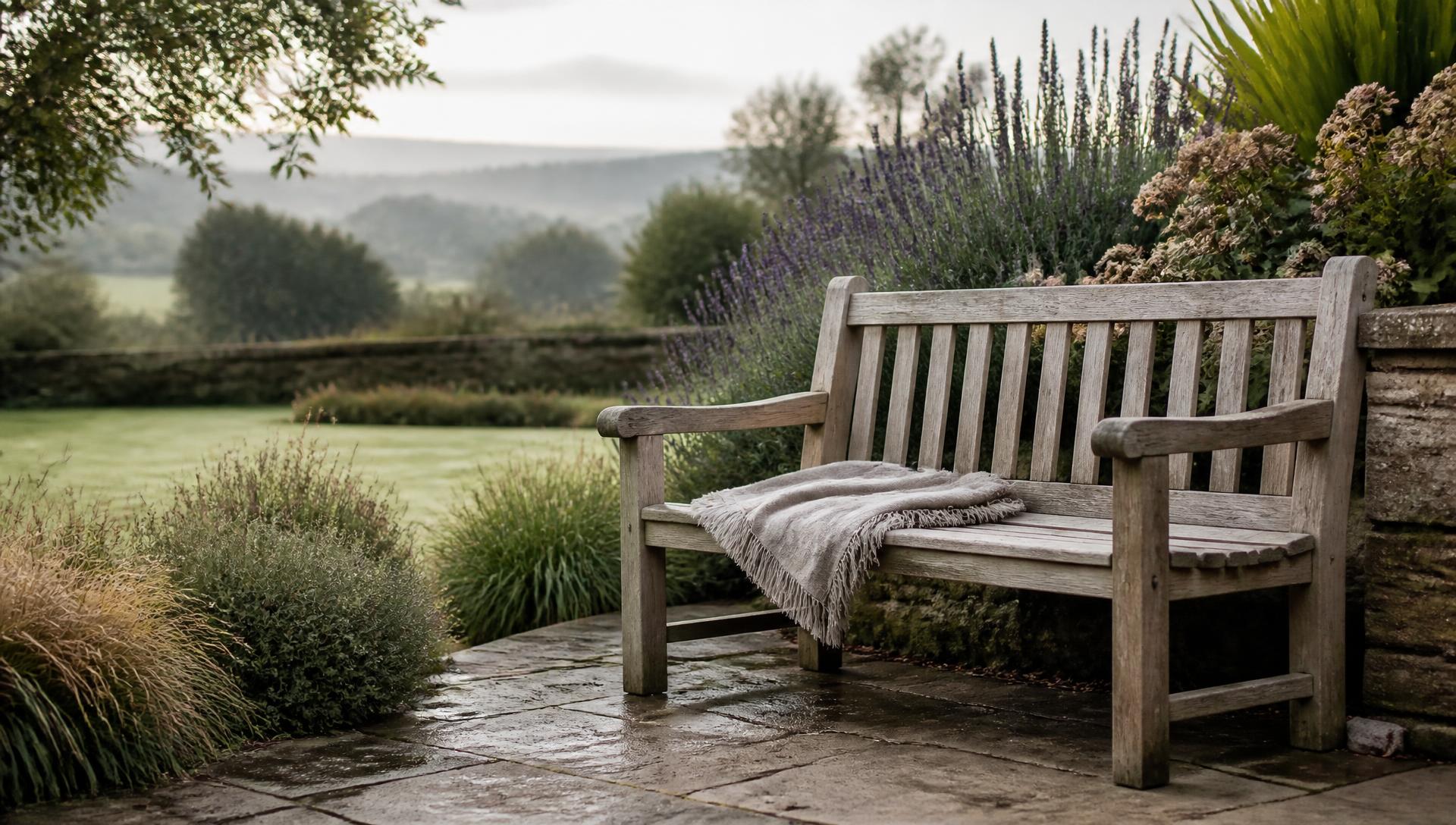
A bench is usually the first proper piece of furniture a garden gets, and often the last one to be replaced. It asks very little of you — no cushions to drag indoors, no parasol to wrestle with — and in return it quietly fixes the shape of the space around it. Get it right and it becomes the place everyone drifts towards with a cup of tea. Get it wrong and it becomes something you walk past.
There is no single best bench. There is the bench that suits your material tolerance, your measurements and how much maintenance you genuinely enjoy. This guide walks through all three, in that order.
The short version. Buy teak if you want to forget about it. Buy aluminium if you need to move it. Measure the walkway before the bench. And check seat depth and back angle — they matter far more than overall width.
Start with the material
Material decides almost everything else: how the bench ages, how heavy it is, how often you need to think about it, and what it costs. Here is how the common options behave after five British winters.
| Material | Weather tolerance | Upkeep | Weight | Ages into |
|---|---|---|---|---|
| Teak | Excellent, uncovered | Wash yearly; sealer optional | Heavy | Soft silver-grey |
| European oak | Good, prefers shelter | Annual oil to hold colour | Heavy | Warm grey-brown |
| Powder-coated aluminium | Excellent, rust-proof | Soapy water | Light | Unchanged |
| Steel / cast iron | Good if coating intact | Touch up chips each spring | Very heavy | Patina, then rust at chips |
| Recycled composite | Excellent | Rinse occasionally | Medium | Essentially unchanged |
Teak is the benchmark, and for good reason. Its natural oils make it dimensionally stable and highly resistant to rot, so it can be left out all year without cover. Left alone it fades from honey-gold to a soft silver-grey within twelve to eighteen months. That colour change is cosmetic only — the timber underneath is unchanged. Highest upfront cost, lowest ongoing effort.
Oak and other hardwoods are dense, handsome and long-lived, but they move more than teak and will stain paving with tannin in the first year. Give them a sheltered spot and an occasional coat of oil if you want to keep the colour.
Powder-coated aluminium is light enough to move on your own, completely rust-proof and unbothered by rain — the sensible choice for balconies, roof terraces and anywhere near salt air. The trade-off is presence: aluminium rarely feels as substantial as timber.
Steel and cast iron bring enormous character and enormous weight. Perfect if the bench is never moving again. Watch for chips in the coating, which is where corrosion always starts.
Recycled plastic and composite are genuinely maintenance-free and increasingly convincing to look at. Best suited to hard-wearing, high-traffic spots rather than as the centrepiece of a formal garden.
Size it against the space, not the catalogue
A three-seater sounds bigger than it is. In practice a 150cm bench comfortably seats two adults with room for a jacket and a tray; three adults will be shoulder to shoulder. If the bench is your main seating, size up to 165–180cm.
A few numbers worth measuring before you order:
- Walkway clearance — leave at least 70cm in front of the bench for people to pass, and 90cm if it faces a table.
- Table pairing — allow 60cm from the table edge to the bench front so people can slide in.
- Against a wall — add 10cm behind the bench so damp is not trapped between the backrest and the brickwork.
- The route in — measure your side passage and gate. Benches are the piece most often defeated by the way in, not the space itself.
Tip. If you are torn between two widths, put masking tape on the paving at both dimensions and live with it for a day. It settles the question faster than any measurement on paper.
Comfort is in the details
Two benches with identical dimensions can feel completely different. The details that decide it:
- Seat depth of 42–48cm suits most adults. Deeper feels lounge-like but needs cushions to be comfortable upright.
- Back angle — a slight recline of five to ten degrees is the difference between perching and settling in.
- Seat height around 43–45cm. Lower feels relaxed; higher is kinder to knees.
- Arm height of roughly 20cm above the seat lets you rest your elbows naturally.
- Slat spacing — narrow gaps are more comfortable without cushions; wider gaps drain and dry faster.
How it is built
Joinery is the clearest signal of how long a bench will last, and it is usually visible in the product photographs.
- Mortise and tenon joints, pegged or glued, are the traditional benchmark for hardwood benches.
- Through-bolted brass or stainless fixings are excellent, and they can be re-tightened in year eight when the timber has settled.
- Staples, butt joints and mild steel screws are the ones to avoid. Steel fixings bleed black stains into oak and teak within a season.
Check, too, whether the maker sells spare slats and fixings. A bench you can repair is a bench you keep.
Where to put it
Give the bench a reason to exist. The best placements have something to look at, some shelter behind, and sun for part of the day. Stand the legs on a hard, level surface — paving, gravel or a couple of stone pads — rather than directly on soil, which holds moisture against the feet and shortens the life of any material.
If the bench will live under trees, expect sap and bird lime; a quick wash twice a season is far easier than an annual rescue.
Care, by material
- Teak — wash with warm soapy water and a soft brush once a year. To keep the honey colour, apply teak sealer in spring, but only ever to clean, dry timber. Never use a pressure washer; it tears out the soft grain.
- Oak and hardwoods — brush off debris, oil annually if you want the colour, and keep the feet off wet ground.
- Aluminium — soapy water is genuinely all it needs.
- Steel — inspect the coating each spring and touch up chips immediately.
- Composite — rinse when it looks dusty. That is the whole routine.
Covers help, but only if the bench is dry when you cover it. A cover over damp timber does more harm than leaving it out in the rain.
A short buying checklist
- Measure the space, the walkway and the route into the garden.
- Decide honestly how much maintenance you will do.
- Choose the material from that answer, not from the photograph.
- Check seat depth and back angle, not just overall width.
- Look at how it is joined — mortise and tenon or through-bolted brass beats staples and screws every time.
- Confirm the warranty, and whether spare parts will still be available in five years.
Buy once, look after it lightly, and a good bench will outlast most of the garden around it.